 Houdiniswap
Houdiniswap fees: why costs differ and how to check
Houdiniswap fees vary with the selected route, available liquidity, network conditions, slippage settings, and added privacy steps. Compare the expected payout first, then include any gas the connected wallet must pay for a DEX route. The final received amount, the matching order or transaction record, and any separately paid network or withdrawal charge show what that swap cost.
Updated
Key takeaway: Compare the expected payout, route type, and separate estimated network charges before signing, then reconcile them with the settled amount.
Route selection decides which costs apply
The applicable costs depend first on whether the quote uses a Private, No Wallet Connect, or DEX route. These paths reach a similar destination through different mechanisms, so their quoted outputs should not be treated as interchangeable.
Private routes use additional routing to separate the sender and recipient trails. No Wallet Connect routes use a deposit address without the same multi-step privacy path. Their route costs are reflected in the expected payout, although a separate fee charged by the sending wallet or withdrawal venue may sit outside that figure.
A DEX route executes through on-chain contracts. Liquidity-provider pricing, bridge costs where applicable, and expected slippage affect the output quote, while the connected wallet may display a separate network charge for approval or execution.
Compatibility narrows the comparison before cost becomes meaningful. A route must support the selected input, output, networks, amount, and destination format. If only one route satisfies those conditions, an apparently cheaper incompatible quote is not an executable alternative.
Where are fees reflected in the quote?
For deposit-based routes, fees are reflected mainly in the expected payout rather than a universal percentage added later. The quote expresses how much output the selected input should produce after the route’s exchange and routing costs. It may not present every embedded cost as a separate line item.
Read the input amount, expected output, route type, and quote validity together. A larger output can indicate a better offer when the input and timing are identical, but token quantities cannot be subtracted meaningfully when they represent different assets. Any connected-wallet gas prompt must also be included when comparing DEX execution with a deposit route.
Quote, commitment, and settlement records
You can verify the final cost only when the chosen route is compatible, the commitment matches its quote, and the settlement record agrees with the received output. Each stage contributes different evidence.
| Stage | Record to retain | Cost information | Validity or completion condition |
|---|---|---|---|
| Quote | Input, expected output, route type, and expiry | Embedded route effects and any separate gas estimate | Use before the quote expires or any input changes |
| Commitment | Order identifier, deposit record, or signed transaction | Exact deposit amount or the wallet’s network-fee estimate | Must correspond to the selected quote and route |
| Settlement | Finished order, destination transfer, and transaction receipt | Received output and actual separately paid gas | Complete when the order status and destination transfer show the same settled output |
Start with routes supporting the same requested transfer, then compare their expected payouts under the same conditions. After committing, use the matching order or transaction record rather than a fresh quote. The destination amount shows what arrived, while the finalized source transaction record supplies any separate network cost needed for the final comparison.
Why can similar swaps return different amounts?
Two swaps can differ when their route, liquidity, amount, timing, or network conditions differ. A quote is a snapshot of available execution paths, not a permanent conversion schedule. Even the same selections may reach another provider or liquidity path after market conditions change.
Trade size matters because available liquidity is not uniform across every price level. A larger order may consume deeper liquidity and receive a different effective rate. Cross-chain execution can introduce a bridge or solver path, while a private swap adds routing intended to break the direct on-chain link. Those mechanisms change cost even when the input and output labels look similar.
Timing also separates quotes. Market prices, liquidity, gas demand, and route availability can move independently, so a quote captured earlier should not be used to judge a later commitment. Compare routes at the same time and with identical inputs whenever the interface makes both paths available.
Fixed and floating quotes set different boundaries
When a deposit-based route offers a fixed quote, DEX execution remains subject to its on-chain slippage controls. The fixed option binds the quoted output only within its stated validity conditions. Creating or funding the order after that boundary may require a new quote.
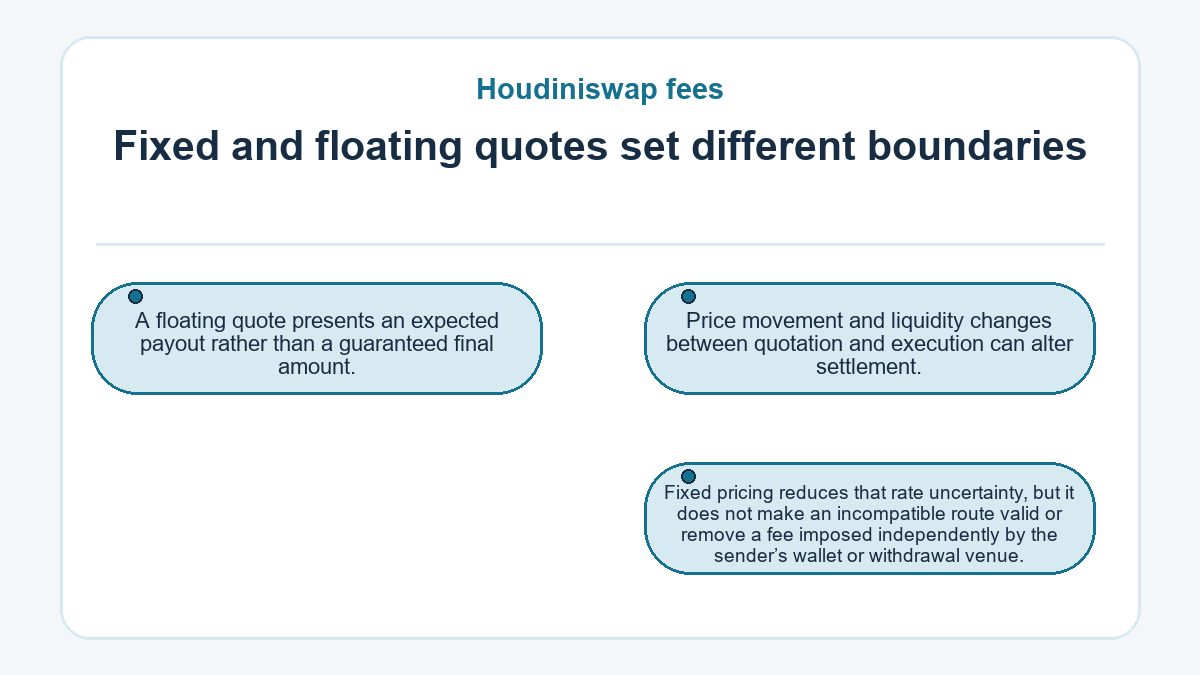
A floating quote presents an expected payout rather than a guaranteed final amount. Price movement and liquidity changes between quotation and execution can alter settlement. Fixed pricing reduces that rate uncertainty, but it does not make an incompatible route valid or remove a fee imposed independently by the sender’s wallet or withdrawal venue.
Network charges behave differently on DEX routes
DEX routes require the user to pay network gas from the connected wallet. The wallet normally estimates that charge before signing, and the finalized transaction record shows the actual network charge. Congestion and transaction complexity can change the final gas cost between estimation and inclusion on the network.
An approval may be required before the swap when the contract lacks permission to spend the selected token. That approval is a separate on-chain transaction and can consume gas. An existing sufficient allowance may remove that step, so the transaction count cannot be assumed from the token pair alone.
Cross-chain DEX routing can combine contract execution with a bridge path. The expected output reflects the selected route, but the connected wallet still needs enough of the source network’s gas asset to authorize required transactions. A favorable output quote cannot execute if the wallet lacks that prerequisite.
Slippage affects execution and failure risk
Slippage tolerance defines how far execution may move from the quoted result before an on-chain swap rejects the trade. It is a protection boundary, not a separate service fee. Market movement and changing liquidity after the quote can consume part of that tolerance, while price impact is reflected in the quoted output.
A wider tolerance permits more movement but does not guarantee completion or reduce network charges. A tighter setting limits the accepted change, although it can increase the chance of a revert when conditions move before execution. Compare the expected output with the minimum accepted output whenever the route shows both values.
For deposit-based floating routes, the same market forces can change the received amount without a user-selected on-chain tolerance. Their order record and final destination transfer therefore matter more than a wallet’s contract parameters.
Which amount shows the final cost?
The received output is the primary settlement figure, but a complete cost check also includes charges paid outside that output. For a DEX route, use actual gas from the transaction receipt. For a deposit sent from another wallet or venue, retain any separately imposed transfer or withdrawal charge.
Economic comparison across different assets requires a common valuation basis taken at the same reference time. Without that basis, subtracting the output quantity from the input quantity produces a meaningless number. The quote remains useful for checking expected execution, while the settled output and separate charge records establish the completed swap’s result.
If the received amount differs from the quote, first distinguish a floating-rate change from a missing transfer or unmatched order. A smaller output alone does not identify the cause. The order status, destination record, and any refund record show whether execution settled, reverted, or requires reconciliation.
Private routing adds cost through extra steps
Private swaps generally cost more because their routing adds an extra step. That path is designed to break the direct on-chain link between sender and recipient. Blockchain activity on the individual legs remains public, so the additional cost pays for added routing rather than erasing those records.
Compare a private quote with another compatible route using the same input, output, amount, and timing. The difference in expected payout expresses the immediate cost tradeoff. Once the swap settles, the destination amount and order record replace the earlier quote as the evidence for that transaction.
Questions and answers about Houdiniswap fees
-
Will Houdiniswap add another fee after I accept the quote?
- The accepted quote reflects route costs in its expected payout; Houdiniswap does not add a separate platform fee afterward. A floating route can still settle differently because prices or liquidity moved. Connected-wallet DEX gas and charges imposed by a sending wallet or withdrawal venue should be tracked separately because they may not be deducted from the displayed output.
-
Do I need a network gas asset for a DEX route?
- Yes, a connected wallet needs enough of the source network’s gas asset for any required approval and execution transactions. The token being swapped does not automatically cover that charge. The wallet should show an estimate before signing, while the finalized transaction record shows the actual network charge after processing.
-
What happens to network fees when a DEX transaction reverts?
- A reverted DEX swap can still consume network gas because the network processed the submitted transaction. When the on-chain transaction reverts, the swap funds remain at the source address, but the gas payment is separate and is not restored. Check the finalized transaction record to confirm the revert and the network charge already used.
-
Is there an extra charge for creating a Houdiniswap payment link?
- Creating a Houdiniswap payment link does not add a link-specific fee. When someone completes the payment, the underlying private swap still carries its normal network and routing costs, which the sender covers. The requested receiver amount is handled separately from those sender-side costs, so the link itself should not be mistaken for a free transaction.
-
Why can sending a different deposit amount invalidate a quote?
- A quote is calculated for a particular input amount, route, and validity period. Sending a different amount changes the conversion request and may no longer match the order’s pricing or limits. Create a quote for the amount actually being sent, and match its deposit instructions rather than assuming the earlier expected payout scales proportionally.
-
When do rewards affect the cost of a completed swap?
- Rewards are determined separately from the execution quote after eligible completed activity. They should not be subtracted from the expected cost before they appear in the applicable reward balance. Eligibility and reward size can depend on the active program terms, swap type, activity, and any qualifying holdings, so the original quote remains the execution record.